Finance
A complete finance back office: invoices and payments with automatic tax resolution across countries, vendor bills tracked to partial payment, budgets checked against live ledger activity, and an optional real double-entry General Ledger every one of those flows can auto-post to.
Problems Solved
- •Billing status is scattered across finance software nobody else in the business can see.
- •Tax rules are hardcoded for one country and break the moment you operate somewhere else.
- •"What did we actually spend against this budget?" means exporting data and rebuilding the answer by hand.
- •Vendor bills and payments are tracked in a spreadsheet that drifts from what's really been paid.
Benefits
- One finance ledger the whole business can see against
- Tax handling that matches where you actually operate, not just where you started
- A budget answer that's always current because it's computed from the same ledger, not a second tracker that can drift
- Every invoice, payment, expense, and vendor bill can auto-post to a real, auditable General Ledger with zero manual journal entry
Features
How It Actually Works
Invoice issued
Tax resolved by the client's country via the Global Tax Engine; GL posts Accounts Receivable (debit) against Sales Revenue and Tax Payable (credit) if GL is enabled.
Payment received
Recorded against the invoice, partial payments supported; GL posts Cash (debit) against Accounts Receivable (credit).
Vendor bill received
Tracked in Accounts Payable; GL posts an Expense (debit) against Accounts Payable (credit).
Vendor bill paid
GL posts Accounts Payable (debit) against Cash (credit) -- the mirror of the payment-received entry.
Budget vs Actual
Pulls the real income statement for the budget's period -- the "actual" side is never a separately-tracked number.
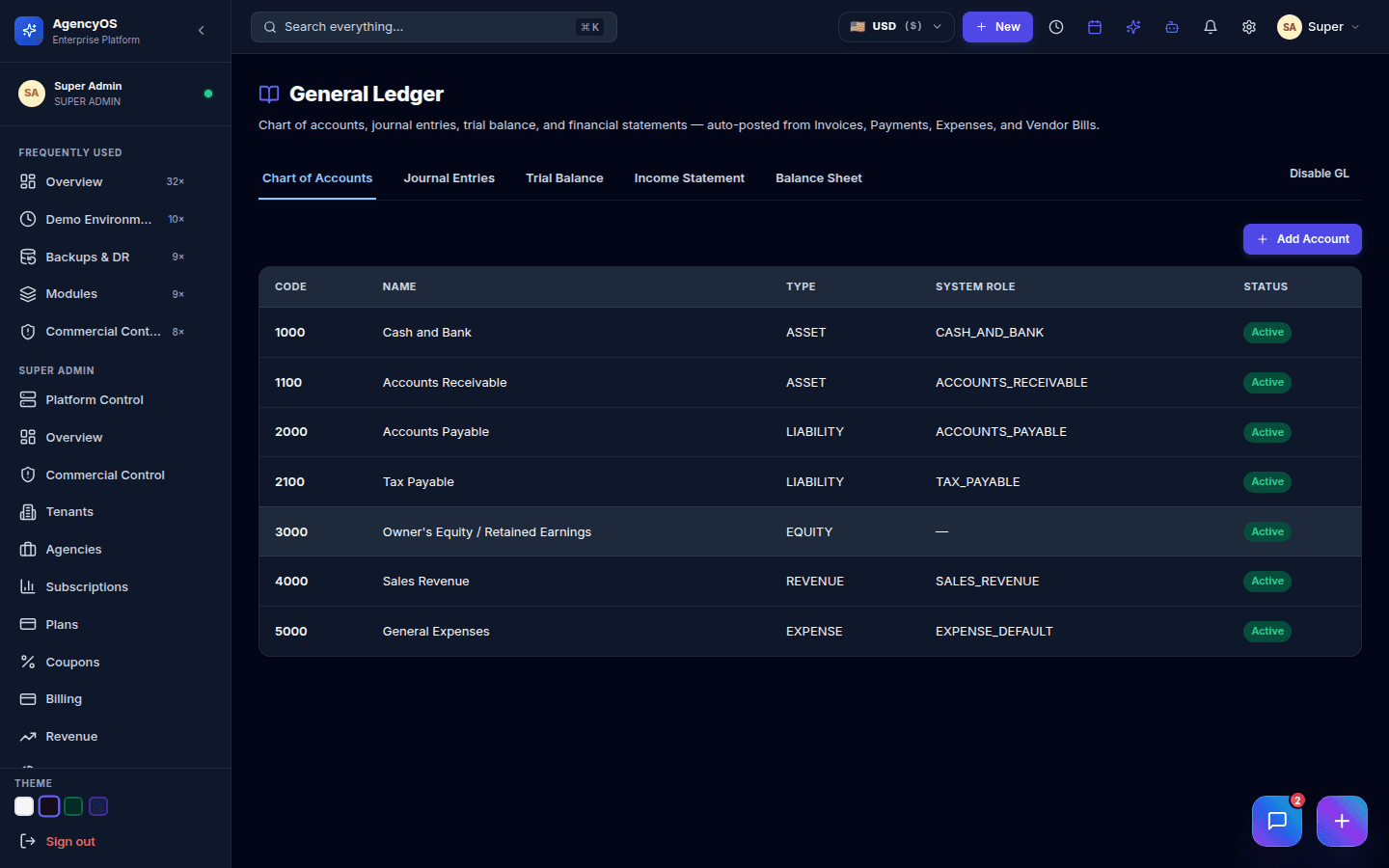
The General Ledger's chart of accounts, seeded automatically the moment it's enabled.
Getting Started
- 1Enable Finance from the Module Marketplace -- invoices, payments, and expenses work immediately with no setup
- 2Enable the General Ledger toggle when you're ready for double-entry bookkeeping -- this seeds a default chart of accounts (Cash, Accounts Receivable, Accounts Payable, Tax Payable, Sales Revenue, General Expenses) automatically
- 3Every invoice, payment, expense, and vendor bill from that point on posts to the ledger with zero manual entry
- 4Create a Budget against any Revenue or Expense account and Budget vs Actual is available immediately -- it reads the same ledger, not a separate import
Used In These Industry Clouds
Related Knowledge Articles
SAVHN Industry Clouds: Frequently Asked Questions
What an Industry Cloud actually is, how it differs from generic SAVHN modules, and exactly which of the 22 real, built industries are actually supported today.
Configuring Dashboards & Reports for Executive Visibility: An Implementation Manual
A practical manual for setting up recurring reports and executive dashboards in SAVHN so leadership gets real visibility without anyone manually compiling it.
Migrating Your Data to SAVHN: A Practical Implementation Manual
A practical manual for planning a SAVHN data migration: what to migrate first, how to sequence it against module rollout, and how to validate what landed.
Configuring Role-Based Permissions Across Every Module: An Implementation Manual
How to design and roll out role-based permissions across every SAVHN module, from role creation to screen-level visibility, without over- or under-granting access.
How NGOs Run Operations on SAVHN NGO Cloud
How nonprofits manage donors, grants, and grant reporting on SAVHN NGO Cloud, from grant proposal through activity-based, funder-facing compliance reporting.
How IT Services Teams Run Operations on SAVHN IT Services Cloud
How software and IT service providers track projects, releases, and incidents on SAVHN IT Services Cloud, from client engagement to SLA-tracked support.
Works Well With
Need help implementing Finance?
Enterprise deployment, workflow design, and data migration — talk to the team that builds it.